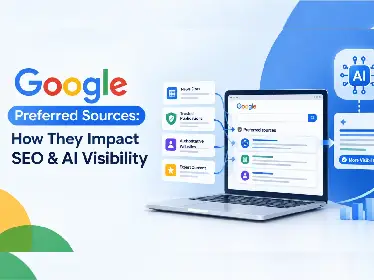
Google Search is becoming more personalized. Users can now tell Google which websites they want to see more often, creating a new layer of visibility for brands and publishers beyond traditional search rankings.
That is where Google Preferred Sources comes in.
Originally introduced for Top Stories, Preferred Sources has now expanded into AI Overviews and AI Mode, allowing users to identify websites they want to see more prominently in their Search experience. The feature is also available globally for Top Stories across supported languages.
For SEO teams, this raises an important question: could being a Preferred Source influence how often your content is discovered, particularly as AI becomes a bigger part of Search?
What Are Google Preferred Sources?
Preferred Sources lets users select websites they trust or regularly want to follow. Once a user selects a website, relevant content from that source can receive greater visibility for that user.
In AI Overviews and AI Mode, selected sources can also receive a "Preferred" label, making them easier to identify within AI-generated responses.
The feature can currently appear across:
- Top Stories
- AI Overviews
- AI Mode
- Google Discover, where source preferences can also influence personalized content
This is important because Preferred Sources is not limited to traditional news publishers. Google's current documentation says websites publishing fresh content can be eligible, and the feature works at the domain or subdomain level, rather than at an individual /blog/ or /news/ directory level.
Is Preferred Sources a Google Ranking Factor?
Not in the conventional sense.
Google describes Preferred Sources as a personalization feature that helps users see content from sources they have selected. It does not say that selecting a website as a Preferred Source automatically improves that site's organic rankings for everyone.
There is, however, an interesting SEO implication.
Google has reported that users are twice as likely to click through to a website after selecting it as a Preferred Source. That makes the feature valuable from an audience and traffic perspective, even without treating it as a direct ranking signal.
Some SEO practitioners have also suggested that widespread adoption could eventually create broader effects through Google's use of user and engagement signals. That remains an industry hypothesis, not a confirmed Google ranking mechanism. For now, brands should view Preferred Sources as a visibility and audience-building opportunity, rather than a shortcut to higher rankings.
Why Preferred Sources Matter for AI Visibility
This is where the feature becomes particularly relevant.
AI Overviews and AI Mode are changing how people interact with Search. Instead of simply scanning a list of blue links, users can now receive synthesized answers with links to websites that provide supporting information and deeper context. Google has continued adding links and website discovery features to its AI experiences.
Preferred Sources adds another layer to that experience.
If a user has already selected your website, relevant content from your domain can be highlighted as a preferred source within AI Overviews and AI Mode.
That creates an interesting relationship between:
Content quality → Audience preference → AI visibility
The implication for brands is straightforward: creating content that people genuinely value can become important not only for ranking, but also for becoming a source users actively choose to follow.
Who Can Use Google Preferred Sources?
The opportunity is broader than many businesses may assume.
Google's documentation does not restrict Preferred Sources to news organizations. Websites publishing fresh content can be eligible, provided they meet Google's requirements. However, there are some important considerations:
- The site must be eligible for the relevant Search experience.
- AI Overviews and AI Mode eligibility requires the site to be included in Google's Search generative AI features in Search Console.
- Preferred Sources works at the domain or subdomain level.
- A specific subdirectory, such as example.com/blog, cannot independently become a Preferred Source.
This makes the feature relevant to brands with active content ecosystems, including SaaS companies, ecommerce brands, publishers, professional services firms, local businesses, and other organizations that regularly publish useful content.
How Can You Set Up Preferred Sources?
Google provides several ways for website owners to encourage visitors to select their site.
The recommended approach is Google's standard JavaScript implementation, which adds an interactive Preferred Source button to your website. Google also provides an advanced implementation for brands that want greater design control.
You can also use a direct link to the source preference tool.
This creates several placement opportunities:
- At the end of high-value blog posts
- Within resource or insights hubs
- In website headers or footers
- Alongside recurring content series
- In email newsletters
- Through social media and other owned channels
Google's newer interactive button is particularly useful because users can select a source and return directly to the page they were reading, creating a relatively frictionless experience.
The strategic consideration is when to ask.
Rather than treating Preferred Sources as another generic CTA, brands should introduce it after delivering genuine value. A reader who has just found an insightful guide or useful analysis is more likely to understand why following that source could be worthwhile.
What Should SEO Teams Do Now?
Preferred Sources does not require a completely new SEO strategy. It should sit alongside the fundamentals that already make content discoverable and useful.
SEO teams should focus on:
- Publishing original, genuinely useful content
- Building authority around relevant topics
- Keeping content fresh and regularly updated
- Creating resources people have a reason to revisit
- Monitoring visibility across traditional Search and AI Search
- Making it easy for engaged audiences to select the brand as a Preferred Source
Google's current guidance for AI Search continues to emphasize established SEO practices and useful, original content. Its latest documentation also highlights the importance of non-commodity content that offers something beyond information that can be easily reproduced elsewhere.
The Bigger Shift in Search
Preferred Sources points to a broader evolution in how Google approaches discovery.
Search is no longer only about matching a query to a webpage. Personalization, AI-generated answers, and user-selected sources are becoming increasingly important parts of the experience.
For brands, that means the question is gradually moving from: "How do we rank for this search?"
To a broader one: "Why would someone choose our brand as a source worth returning to?"
Preferred Sources does not replace SEO, and there is currently no confirmed evidence that selecting a website directly improves its overall organic rankings. But it does give brands another way to strengthen the relationship between useful content, audience preference, and visibility in AI-powered Search.
As Google continues to evolve how people discover information, being visible will matter. But being a source people actively choose could matter just as much.
More Useful Links:-
Generative Engine Optimization Services | Answer Engine Optimization Services | SEO Company in Gurgaon